|
|

|
|
|
HMS Arethusa, 1914, 1915 and 1916, WW1
HMS Arethusa launched on 25 October 1913, a Arethusa class light cruiser, played a key role in the World War 1 naval encounters.
|
|
|
|
On 27 August 1914, at the start of the Great War, Arethusa became the flagship of Commodore Reginald Tyrwhitt, commander of the Harwich Force.
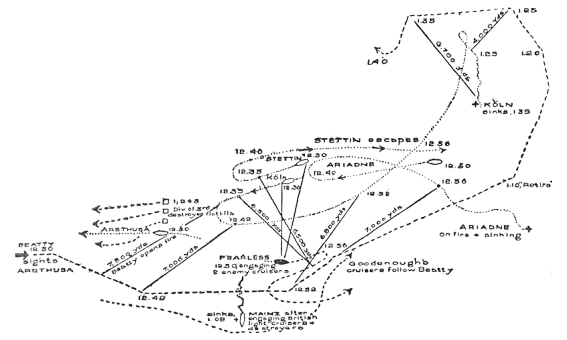
On 28 August 1914 she fought at The Battle of Heligoland Bight, as the flag-ship of Commodore Reginald Tyrwhitt. She sank 2 torpedo boats around 7am. She was seriously damaged by a shell from German navy's SMS Frauenlob - claiming the lives or wounding 27 of the Arethusa crew, and also sustaining other damage from SMS Stettin. After being towed home, she was repaired. Commodore Keyes, commander of the Submarine Flotilla also played a key role. After this battle Kaiser Wilhelm ordered his Imperial Navy to, 'Hold itself back and avoid actions which can lead to greater losses.' Repairs took until September to complete.
The Arethusa led the Harwich Force during the first phase of the battle, the attempted British ambush. She then came into contact with two German cruisers, Stettinand Frauenlob, and was badly damaged by gunfire. All but one 6in gun was knocked out, and the ship slowed. During the battle all but two of the 4in guns were repaired, but she was then attacked by the German cruiser Stralsund, and was in some danger when the British battlecruisers arrived. After the battle she had to be towed back to port by the Hogue, having lost Lieutenant Eric W. P. Westmacott (the Signal Officer) and 9 ratings who died in the battle and another 17 wounded, one of these died of wounds later. She was still being repaired in mid-September.
Also of note, at Heligoland Bight the following crew of Arethusa came under notice of Commodore Tyrwhitt for their actions: |
|
Lieutenant-Commander Arthur P. N. Thorowgood, First Lieutenant, and in charge of the After Control.
Lieutenant-Commander Ernest K. Arbuthnot (G.), in charge of the Fore Control.
Sub-Lieutenant Clive A. Robinson, who worked the range-finder throughout the entire action with extraordinary coolness.
Assistant Paymaster Kenneth E. Badcock, my Secretary, who attended me on the bridge throughout the entire action.
Mr. James Douglas Godfrey, Gunner (T.), who was in charge of the torpedo tubes. Awarded the Distinguished Service Cross.
Armourer Arthur F. Hayes, O.N. 34202G (Ch.).
Second Sick Berth Steward George Trolley, O.N. M. 296 (Ch.).
Chief Yeoman of Signals Albert Fox, O.N. 194656 (Po.), on fore bridge during entire action. Awarded the DSO.
Chief Petty Officer Frederick W. Wrench, O.N. 158630 (Ch.) (for ready resource in extinguishing fire caused by explosion of cordite). Awarded the DSO.
Private Thomas Millington, R.M.L.I., No. Ch. 17417.
Private William J. Beirne, R.M.L.I., No. Ch. 13540.
First Writer Albert W. Stone, O.N. 346080 (Po.).
|
|
|
|
|
|
|
On 3 November 1914, Arethusa was one of the British ships mobilised in an attempt to catch the German ships that had attacked Yarmouth, without success. On 25 December she was part of the force that protected the seaplane raid against Cuxhaven.
Arethusa played a part in The battle of Dogger Bank, 24 January 1915, firing two torpedoes into the German cruiser SMS Blücher, sinking it. Later she returned to the scene and rescued 260 survivors of Blücher.
In June 1915 she became flagship of the newly formed 5th Light Cruiser Squadron, while remaining Tyrwhitt's flagship. In that capacity she operated in the Borkum seaplane raid of July 1915, and took part in the chase of the German minelayer Meteor - this ship was scuttled when it became clear that she was surrounded by significant British forces.
On 25 December 1915, HMS Arethusa took part in the Cuxhaven Raid. In 1915 she was transferred to the 5th Light Cruiser squadron of the Harwich force. In September 1915 she captured four German trawlers. Arethusa did not engage the enemy at The Battle of Jutland on 31 May 1916 - 1 June 1916, instead defending the British coast in case of enemy attack.
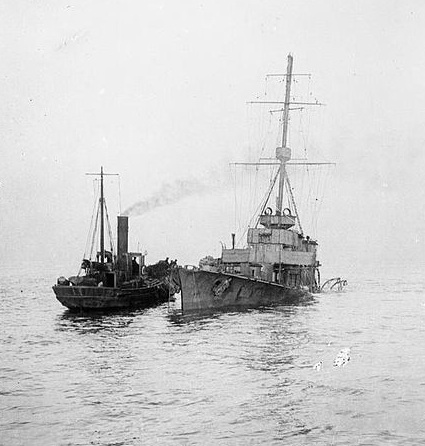
On 11 February 1916 she struck a mine off Felixstowe. The mine had been laid by the German submarine UC 7 on the previous day. The explosion killed six men. The engine stopped immediately, and the ship soon began to settle lower in the water. An attempt to tow her to safety failed, and she ran aground on Cutler Shoal. Attempts to retrieve her lasted until August, when the hulk was abandoned and allowed to break up.
Commodore Tyrwhitt received the DSO in 1916, and had a distinguished career with the Royal Navy after the war, eventually becoming Admiral of the Fleet in 1934 and later a Baronet. His First Lieutenant, Arthur Penton Napier Thorowgood was later promoted to Commander and also earned the DSO.
Follow us for more World War 1 updates over the centenary »
|
|
|
|